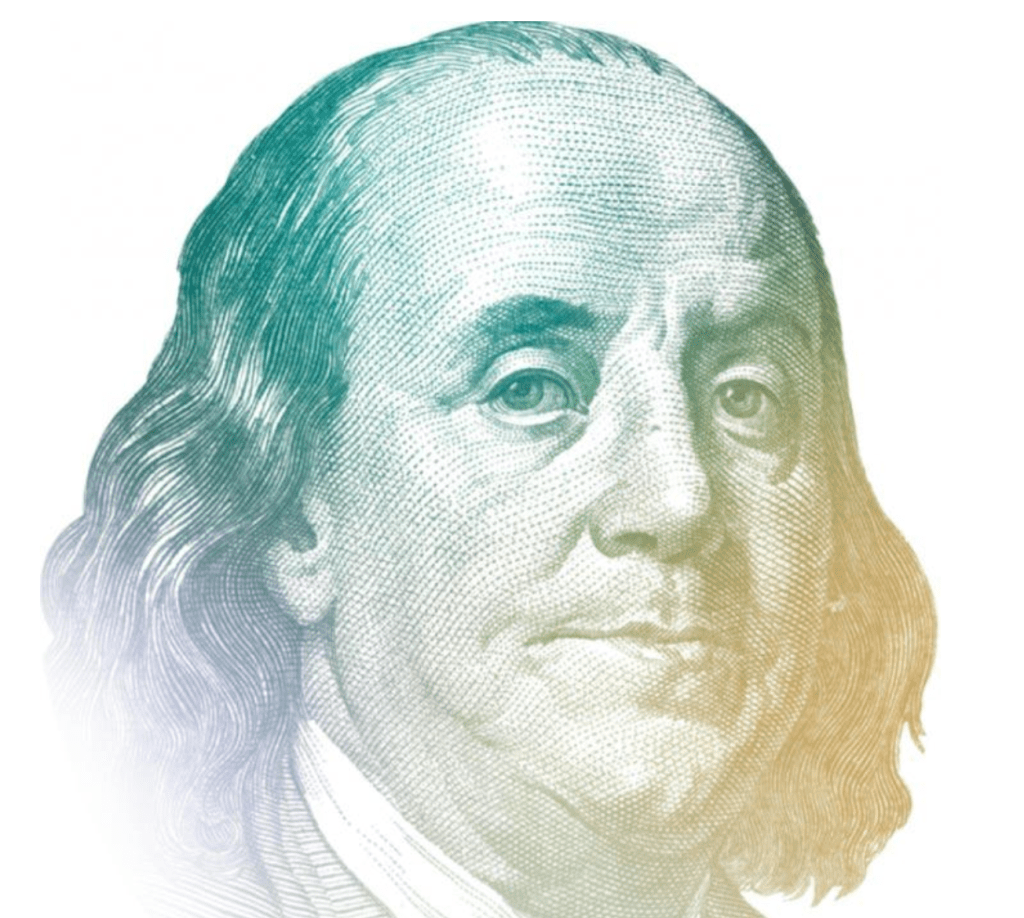
Benjamin Franklin – Self Help
Benjamin Franklin’s Guide to Personal Excellence
Benjamin Franklin’s rise from a humble apprentice to a globally respected polymath was the result of a deliberate, lifelong system for character development known as his Virtue Method.
Franklin’s 13 Timeless Virtues – 1. Temperance 2. Silence 3. Order 4. Resolution 5. Frugality 6. Industry 7. Sincerity 8. Justice 9. Moderation 10. Cleanliness 11. Tranquility 12. Chastity 13. Humility
Refine your daily habits and build a life of purpose using the structured self-improvement virtue framework of Benjamin Franklin.
Ben Franklin – Self Improvement
Franklin’s quotes on his 13 virtues and precepts for your self improvement.
Temperance
(Eat not to dullness. Drink not to elevation.)
A fat kitchen, a lean will.
A full belly is the mother of all evil.
A full belly makes a dull brain.
Be temperate in wine, in eating, girls, and cloth, or the gout will seize you and plague you both.
Cheese and salt meat should be sparingly eaten.
Dine with little, sup with less: Do better still: sleep supperless.
Drunkenness, that worst of evils, makes some men fools, some beasts, some devils.
Eat few suppers, and you will need few medicines.
Eat to live; live not to eat.
He that never eats too much, will never be lazy.
He that spills the rum loses that only; He that drinks it, often loses both that and himself.
If it were not for the belly, the back might wear gold.
Many dishes, many diseases.
No wonder Tom grows fat: the unwieldy sinner makes his whole life but one continual dinner.
Nothing more like a fool, than a drunken man.
Three good meals a day is bad living.
To lengthen your life, lessen your meals.
When the wine enters, out goes the truth.
Franklin’s Book of Virtues that he used to track his self improvement.
Temperance
Eat not to dullness. Drink not to elevation.
Silence
Speak not but what may benefit others or yourself. Avoid trifling conversation.
Order
Let all your things have their places. Let each part of your business have its time.
Resolution
Resolve to perform what you ought. Perform without fail what you resolve.
Frugality
Make no expense but to do good to others or yourself; i.e., waste nothing.
Industry
Lose no time. Be always employed in something useful. Cut off all unnecessary actions.
Sincerity
Use no hurtful deceit. Think innocently and justly; if you speak, speak accordingly.
Justice
Wrong none by doing injuries or omitting the benefits that are your duty.
Moderation
Avoid extremes. Forbear resenting injuries so much as you think they deserve.
Cleanliness
Tolerate no uncleanliness in body, clothes, or habitation.
Tranquility
Be not disturbed at trifles, or at accidents common or unavoidable., or at accidents common or unavoidable.
Chastity
Rarely use venery but for health or offspring, never to dullness, weakness, or the injury of your own or another’s peace or reputation.
Humility
Imitate Jesus and Socrates.
“IT was about this time I conceived the bold and arduous project of arriving at moral perfection. I wished to live without committing any fault at any time; I would conquer all that either natural inclination, custom, or company might lead me into, As I knew, or thought I knew, what was right and wrong, I did not see why I might not always do the one and avoid the other.
Worksheets inspired by Ben Franklin & latest research for your self improvement.
“The advice of Pythagoras in his Golden Verses, daily examination would be necessary…” – Benjamin Franklin.
Virtues Journal
Adopting Benjamin Franklin’s 13 Virtues as a structured framework for self-improvement offers a powerful, methodical approach to personal growth and goal achievement. By tracking specific traits like Industry, Frugality, and Resolution in a daily journal, an individual transforms abstract moral goals into measurable habits. Franklin’s genius lay in his “one-at-a-time” strategy: focusing on a single virtue each week allowed him to build a foundation of discipline without becoming overwhelmed by the scope of his own imperfections. This practice cultivates self awareness, forcing a person to become an objective observer of their own behavior and progress. Over time, this consistent self-monitoring breeds the integrity and clarity of mind necessary to navigate life’s challenges, ultimately providing the internal stability required to reach long-term professional and personal milestones.
Link to the Virtues Journal
Ben Franklin’s Poor Richard’s Almanac is filled with Franklin’s wisdom.
A change of fortune hurts a wise man no more than a change of the moon.
A child thinks 20 shillings and 20 years can scarce ever be spent.
A cold April, the barn will fill.
A country man between two lawyers, is like a fish between two cats.
Act uprightly, and despise calumny; dirt may stick to a mud wall, but not to polished marble.
A brother may not be a friend, but a friend will always be a brother.
A cypher and humility make the other figures and virtues of tenfold value.
A false friend and a shadow attend only while the sun shines.
A father’s a treasure; a brother’s a comfort; a friend is both.
A fat kitchen, a lean will.
A fine genius in his own country, is like gold in the mine.
A flatterer never seems absurd: The flattered always takes his word.
After three days men grow weary of a wench, a guest, and weather rainy.
After crosses and losses men grow humbler and wiser.
After Fish, Milk do not wish.
A full belly is the mother of all evil.
A full belly makes a dull brain.
A good example is the best sermon.
A good lawyer, a bad neighbor.
A good man is seldom uneasy, an ill one never easy.
A good wife lost, is God’s gift lost.
Franklin’s Way to Wealth is highly regarded for its commons sense and aphorisms.
I HAVE heard that nothing gives an author so great pleasure, as to find his works respectfully quoted by others. Judge, then, how much I must have been gratified by an incident I am going to relate to you. I stopped my horse, lately, where a great number of people were collected at an auction of merchants’ goods. The hour of the sale not being come, they were conversing on the badness of the times; and one of the company called to a plain, clean old man, with white locks, “Pray, Father Abraham, what think you of the times? Will not the heavy taxes quite ruin the country? How shall we be ever able to bear them? What would you advise us to do?” Father Abraham stood up, and replied, “If you would have my advice, I will give it you in short; for a word to the wise is enough,’ as poor Richard says.” They joined in desiring him to speak his mind, and gathering round him, he proceeded as follows:
“Friends,” says he, “it may be the times are bad, but let us see whether the fault is not our own. Our expenses are doubled by idleness, and trebled by pride and folly; and these can only be abated by our own exertions. If we hearken to good advice, we may gain something. God helps them that help themselves,’ as poor Richard says.
Franklin’s autobiography is a history book & an influential self help work of its own.
Twyford, at the Bishop of St. Asaph’s, 1771.
DEAR SON: I have ever had pleasure in obtaining any little anecdotes of my ancestors. You may remember the inquiries I made among the remains of my relations when you were with me in England, and the journey I undertook for that purpose. Imagining it may be equally agreeable to you to know the circumstances of my life, many of which you are yet unacquainted with, and expecting the enjoyment of a week’s uninterrupted leisure in my present country retirement, I sit down to write them for you. To which I have besides some other inducements. Having emerged from the poverty and obscurity in which I was born and bred, to a state of affluence and some degree of reputation in the world, and having gone so far through life with a considerable share of felicity, the conducing means I made use of, which with the blessing of God so well succeeded, my posterity may like to know, as they may find some of them suitable to their own situations, and therefore fit to be imitated.
That felicity, when I reflected on it, has induced me sometimes to say, that were it offered to my choice, I should have no objection to a repetition of the same life from its beginning, only asking the advantages authors have in a second edition to correct some faults of the first. So I might, besides correcting the faults, change some sinister accidents and events of it for others more favorable. But though this were denied, I should still accept the offer. Since such a repetition is not to be expected, the next thing most like living one’s life over again seems to be a recollection of that life, and to make that recollection as durable as possible by putting it down in writing.
About Franklin
Ben Franklin In His Own Words
Born in Boston on January 17, 1706, young Franklin struck out on his own in 1723, eventually finding employment as a journeyman printer in Philadelphia. Franklin’s newspaper The Pennsylvania Gazette, his Poor Richard’s Almanack, and work as an inventor and scientist propelled him to the front ranks of Philadelphia society and made him a well-known figure throughout the American provinces and England.
In 1757, at age fifty-one Franklin, began his career as a diplomat and statesman in London where he essentially remained until the outbreak of the American Revolution. When Franklin returned to Philadelphia in 1775, he served as a delegate to the Continental Congress, where he was instrumental in drafting the Declaration of Independence and the Articles of Confederation. Because of his international experience, Franklin was chosen as one of the first ministers to France. In Paris Franklin reached his peak of fame, becoming the focal point for a cultural Franklin-mania among the French intellectual elite. Franklin ultimately helped negotiate a cessation of hostilities and a peace treaty that officially ended the Revolutionary War.
Even after his death in 1790, Franklin remained an American celebrity. Shortly after his death, his now famous autobiography was published in France and was followed two years later by British and American editions. Perhaps, the last, best summary should be the simple words of James Madison taken from his notes on Franklin: “I never passed half an hour in his company without hearing some observations or anecdote worth remembering.”